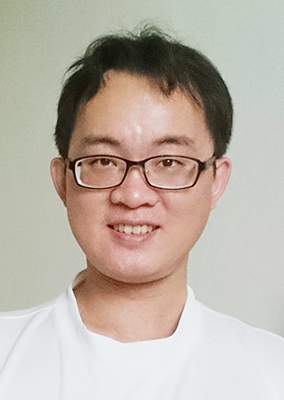
Jeng-Shin Wu is an Associate Research Fellow at the Research Center for Curriculum and Instruction, National Academy for Educational Research (NAER). He has extensive research experience in educational testing, mathematics education, and competency-based assessment. His areas of expertise include educational statistics, test theory, instruction and assessment focused on mathematical literacy, and the application of generative artificial intelligence (AI) in educational assessment.
After graduating with a degree in mathematics, Wu began his career in educational testing and large-scale educational surveys. He participated in the Programme for International Student Assessment (PISA), contributed to the development of various educational assessment instruments, and developed test items for high-stakes examinations. These experiences enabled him to acquire substantial practical expertise in educational assessment, test analysis, and item design, laying the foundation for his subsequent research on competency-based assessment.
Since joining NAER, Wu has continued to advance research on mathematical literacy instruction and assessment. He has served as principal investigator for several major research projects supported by the Ministry of Education and NAER, including the “Training Program for Competency-Based Assessment Item Developers,” “Longitudinal Study of Mathematical Literacy at the Fourth Learning Stage,” “Bringing Competency-Based Assessment into the Classroom,” and “Assessment as Learning.” His work focuses on establishing mathematical literacy assessment frameworks, developing item-design methods, analyzing student learning performance, and strengthening mathematics teachers’ capacity to develop competency-based assessment items across Taiwan. He has also regularly been invited to lead teacher professional development sessions and workshops in cities and counties throughout Taiwan. His research findings are presented in Literacy-Based Assessments Research and Development guide (2022), which systematically introduces the principles, development processes, and practical examples of competency-based assessment. The book serves as an important resource for advancing mathematical literacy assessment and teacher professional development.
In recent years, Wu’s research has focused on the application of generative AI and large language models (LLMs) in educational assessment. By incorporating prompt engineering, retrieval-augmented generation (RAG), chain-of-thought reasoning, and multi-agent collaboration into the development of mathematical literacy assessment items, he has progressively established AI-assisted item-development methods that combine knowledge-based guidance, reasoning processes, and quality control. His work also includes the development of automated item generation, multimodal assessment, and intelligent assessment systems. His research has been published in journals on mathematics education and teacher professional development, addressing AI-assisted competency-based assessment design, item-generation methods that combine prompt engineering with LLMs, and the use of RAG and structured prompting to improve the quality of AI-generated items. Through this work, he seeks to establish a new generation of intelligent assessment approaches that integrate educational theory, assessment quality, and AI technologies. These research findings are expected to be published in 2027 in AI-Assisted Generation of Mathematical Literacy Assessment Items.
Wu’s research also encompasses the integration of social and emotional learning (SEL) into mathematics learning. He is conducting the project “Evidence-Based Mathematics Curriculum Design and Learning Assessment Based on International Comparative Studies,” which examines instructional design and assessment approaches for integrating SEL into mathematics learning processes. Drawing on data from international comparative studies, the psychology of mathematics learning, and SEL theories, his research explores the relationships among students’ emotions, beliefs, and learning processes. It aims to develop a framework for mathematics learning that addresses both cognitive abilities and affective development. These research findings are expected to be published in 2027 in Reframing Emotions, Making Learning Easier: Theory and Practice of Integrating Social and Emotional Learning into Mathematics Classrooms.
 Home
 Sitemap
 FAQ
 Feedback Mailbox


 facebook
 youtube